
AI tokenomics needs more than cost per token:
As standards emerge, enterprises need a governance model that connects AI consumption to cost, risk, quality, and business value.

AI tokenomics is still emerging, and cost per token is only one part of the measurement challenge. Enterprises need governance that connects AI consumption to cost, quality, risk, adoption, and business outcomes. While standards are still forming, organizations should build a practical operating model to make better AI investment decisions now.
AI economics has moved into the boardroom. Reports like the 2026 State of FinOps report reinforce this, showing that 98% of respondents now manage AI spend, and 78% of teams now report to the CTO or CIO.
As organizations move from experimentation to production, leaders are no longer asking only whether generative AI can produce impressive results. They are asking whether AI can scale economically, securely, and consistently across the enterprise.
That shift is why tokenomics is getting so much attention. The emerging discipline of Tokenomics helps organizations understand how they produce, consume, price, govern, and connect tokens to value.
Every prompt, response, retrieval step, summarization, agent action, and model interaction consumes tokens. As AI usage grows, token volume becomes a real driver of cost, performance, infrastructure planning, forecasting, and return on investment.
But the discipline is still early. The market does not yet have a standardized measurement layer. Cost per token is the most widely adopted metric because it gives organizations a concrete way to understand part of AI consumption. But it is not a complete measure of AI.
The industry is still working out how to define, measure, govern, and forecast AI economics across use cases, model types, deployment models, and business outcomes. No single framework has solved this yet. The responsible conversation is not to pretend the answer already exists. It is to help practitioners ask better questions while common language, standards, and operating models continue to mature.
For enterprise leaders, the better question is not simply, “How cheaply can we produce tokens?” It is, “How do we understand the economics of useful AI output when the measurement layer is still being built?”
Why cost per token is not enough for AI tokenomics
Cost per token helps explain part of the supply side of AI economics. It gives infrastructure, engineering, finance, and procurement teams a way to discuss inference efficiency, throughput, power consumption, GPU utilization, latency, model performance, and full-stack optimization.
That is especially useful when comparing AI factories, inference platforms, cloud services, on-premises GPU environments, neocloud options, and hybrid deployment models. If an organization is running sustained AI workloads, infrastructure design matters. Tokens per watt, latency, utilization, context management, and workload placement can materially affect the economics of production AI.
But cost per token has limits. The challenge is not only that it lacks business context. It is that the token itself is not always a stable economic unit.
Model changes, quantization, context handling, routing decisions, quality thresholds, and vendor pricing models can shift cost, performance, and output quality without giving business leaders a clean apples-to-apples comparison. A model may keep the same name, endpoint, or headline price while the economics of using it change underneath. That makes it risky to treat cost per token as a fixed benchmark or universal planning unit.
In other words, the question is not only whether tokens are cheap. It is whether the organization understands what those tokens are doing, what quality they support, what risks they introduce, and whether the cost assumptions behind them are still valid.
Why AI cost forecasting is getting harder
Many enterprise AI business cases have assumed that model prices will keep falling as usage scales. That assumption is no longer safe enough to carry planning on its own.
Vendor pricing models are still changing. Inference patterns are changing. Context windows, retrieval strategies, agentic workflows, model routing, and quality requirements can all alter the cost curve. The economics of a pilot may look very different from the economics of a production workflow running across thousands of users, multiple systems, and repeated business processes.
That creates a practical challenge for leaders. They cannot change the cost decisions already made, but they do need a better way to forecast what happens next. AI economics models need to be stress-tested against uncertainty, not optimized only against today’s token prices.
This is where tokenomics becomes more than unit-cost tracking. It becomes a planning discipline: one that helps organizations understand how consumption, quality, architecture, governance, and future pricing scenarios interact.
How model routing changes AI cost management
As organizations move beyond single-model experiments, model routing is becoming a central part of the AI economics conversation.
A single workflow may now touch multiple models, retrieval layers, agents, validation steps, and policy controls. One task might start with a lower-cost model, escalate to a more capable model, call a retrieval system, invoke an agent, and then pass through a human or automated validation layer. Each step can change the cost, quality, latency, and risk profile of the workflow.
That makes attribution harder. If the workflow succeeds, which part created the value? If it fails, which part created the waste? If cost increases, is that because the model is too expensive, the routing logic is poor, the context is too broad, the data is weak, or the workflow itself is not well designed?
Cost per token can help identify one part of that picture. But it cannot, by itself, explain whether a routed AI workflow delivered the right outcome at an acceptable cost, quality, latency, and risk level.
Why leaders should not treat tokens as AI commodities
Token pricing can create a misleading impression that tokens are commodities.
Because tokens can be counted, priced, and compared, it is tempting to treat them as interchangeable units of AI output. That is a dangerous simplification.
Tokens may be metered like a commodity, but they are not economically equivalent. A token generated from poor data, irrelevant retrieval, or an unrevised workflow may create cost without creating value. A token used in a well-designed, governed, outcome-driven workflow can support a decision, resolve a task, reduce risk, or improve customer experience.
Consider a customer support workflow. A poorly designed AI assistant may consume fewer tokens by giving short, generic answers, but still increase escalation rates if the answer is incomplete, unsupported, or disconnected from the customer’s context. A better-designed workflow may consume more tokens because it retrieves the right policy, checks the customer record, validates the response, and routes exceptions appropriately. The second interaction may cost more per response, but it can be more economically defensible if it resolves the issue, reduces rework, and improves customer experience.
This is where AI economics becomes more complicated than traditional unit-cost analysis. The cheapest token is not always the most efficient token if it produces low-quality output, increases rework, or shifts risk elsewhere in the business.
Why AI readiness matters as much as AI infrastructure
The MIT GenAI Divide – State of AI in Business 2025 report, highlighted a persistent gap between broad experimentation and measurable production impact, with the report finding 95% of organizations canvassed achieved zero return on their GenAI use.
The issue is not only whether organizations can produce AI output. It is whether AI is embedded into real workflows, supported by the right data, and governed in a way that allows value to scale.
AI strategies often begin with model selection and infrastructure decisions. Those are important, but they are not always the primary constraint. In many organizations, the bigger constraint is operational readiness.
If data is fragmented, retrieval quality suffers. If workflows are poorly defined, AI automates confusion. If prompts are inconsistent, outputs vary. If evaluation criteria are weak, teams rerun experiments without knowing whether they are improving. If organizations do not govern agents, they may scale risk along with usage.
This is the gap token metrics alone cannot solve. A faster AI environment does not fix poor inputs, unclear processes, or weak governance. It can amplify them.
Who should own AI tokenomics governance?
One of the most important unanswered questions is ownership.
Should token economics sit with FinOps, ITAM, platform engineering, procurement, finance, data science, or a cross-functional governance group? The answer may vary by organization. But the conversation cannot remain isolated inside engineering teams, and it cannot be reduced to infrastructure cost alone.
This is where the tokenomics conversation begins to split into two connected layers.
- One is the financial operating model: visibility, allocation, unit economics, forecasting, showback/chargeback, and optimization. This focuses on Return on Investment (ROI) and Total Cost of Ownership (TCO).
- The other is the enterprise value model: how AI affects workflows, risk, mission impact, compliance, user productivity, operational readiness, governance, adoption, strategic alignment, and measurable business outcomes. Here the focus is on Cost Benefit Analysis (CBA).
TCO and ROI may tell us whether the investment is financially defensible, but CBA tells us whether it is the right investment for the enterprise.
FinOps practitioners are well positioned to own the first layer. But the second layer — connecting AI activity to enterprise value in a consistent, defensible way — is still being defined.
Organizations that treat these as separate problems will struggle to build a credible governance model. This is where SHI can help bridge the gap. As FinOps experts, SHI helps organizations build the financial discipline around AI consumption. Through SHI’s Advanced Growth Technologies (AGT) group, the work extends into the enterprise layer, helping customers govern both sides of the model: how AI is consumed, and how that consumption translates into business value.
Organizations need shared language before they can build reliable controls. They need practitioner input before they can standardize benchmarks. And they need governance models that reflect how AI is being consumed across the enterprise.
What enterprise leaders should ask about AI spend now
The goal should not be to produce the fewest tokens. In some cases, using fewer tokens may reduce context, quality, accuracy, or trust. The better goal is to understand the cost of useful output without pretending that the industry has already standardized what useful output means in every scenario.
Until the standards layer matures, leaders can begin by asking more practical questions. These questions need to be answered across both layers – the financial model that explains cost, and the value model that explains impact:
- Which AI use cases are moving from experimentation into repeatable production workflows?
- What business outcome is each workflow meant to support?
- What is the full cost of the workflow, including models, retrieval, routing, infrastructure, validation, and human oversight?
- How do quality, latency, compliance, and risk requirements affect the economics?
- What assumptions are being made about future model pricing, usage growth, and vendor commercial models?
- Who owns the measurement, governance, and optimization of AI consumption?
These questions force organizations to look beyond AI consumption and ask whether the work being done by AI is useful, repeatable, governed, measurable, and economically defensible.
They may eventually lead to measures such as cost per resolved task, cost per completed workflow, cost per supported decision, cost per compliant response, cost per developer cycle reduced, or cost per business outcome achieved. But those measures are not yet standardized across industries, use cases, or model types. They should be treated as starting points for practitioner discussion, not finished benchmarks.
That is exactly why the market needs shared language, open standards, and coordinated practitioner input. Industry efforts such as the emerging Tokenomics Foundation reflect a broader need for common definitions, benchmarks, and best practices.
How to govern AI consumption while tokenomics standards mature
Enterprise AI economics cannot end with production efficiency, and tokenomics should not be presented as a solved framework before the industry has built the standards to support it.
The next phase is about useful output, shared language, and responsible governance. That governance cannot sit in one domain alone. It requires a model that connects financial discipline, including cost visibility, attribution, and optimization, with enterprise value like workflow impact, quality, risk, adoption, and measurable outcomes.
This is the emerging shape of tokenomics: not just a way to price tokens, but a way to govern how AI consumption translates into business value. While the standards are still forming, organizations that begin building this combined operating model now will be better positioned to define what “good” looks like as the market matures.
The future of AI economics will not be defined by the cheapest token alone. It will be defined by the ability to connect AI consumption to reliable outcomes, and to govern both sides of that equation with confidence.
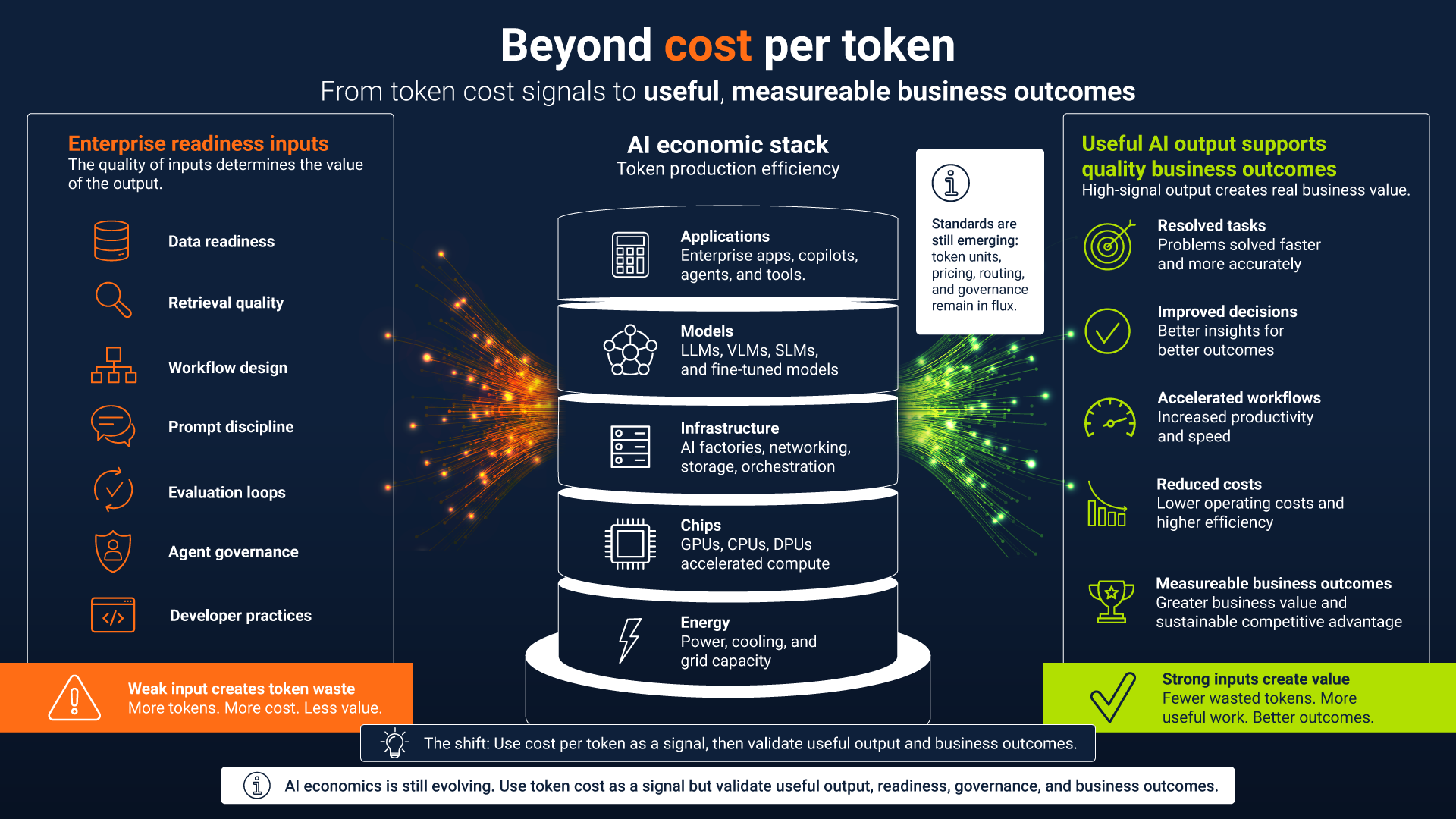
Moving beyond cost per token: how strong inputs and a well-optimized AI stack translate into measurable business outcomes.
NEXT STEPS:
Speak to an SHI expert about how to manage your AI spend.
This topic is growing in importance. These related articles on tokenomics, FinOps for AI, and AI spend are popular with other readers:
Tech spend needs a better operating model
Frequently asked questions
What is AI tokenomics?
AI tokenomics helps enterprises understand how they consume, price, govern, and connect AI tokens to business value. Every prompt, response, retrieval step, model call, agent action, and automated workflow consumes tokens, making token consumption a critical factor in AI cost management, governance, and planning.
Why is cost per token not enough to measure AI value?
Cost per token shows part of the cost picture, but it does not explain whether the output was useful, accurate, compliant, or valuable to the business. A lower-cost model may produce cheaper tokens, but those tokens can still create rework, risk, or poor user experiences if the workflow is not well designed.
How should enterprises measure AI spend?
Enterprises should measure AI spend at both the financial and business-value level. That means tracking token usage, model costs, infrastructure, routing, retrieval, validation, and human oversight, while also measuring outcomes such as resolved tasks, completed workflows, productivity gains, risk reduction, or improved customer experience.
What is the difference between AI tokenomics and FinOps for AI?
FinOps for AI applies financial accountability, visibility, allocation, forecasting, and optimization practices to AI spend. AI tokenomics is a broader discipline that looks at how token consumption behaves economically and how that consumption connects to quality, governance, risk, and enterprise value.
Why does AI cost forecasting get harder as usage scales?
AI cost forecasting gets harder because production workflows often consume tokens in ways that pilots do not reveal. As organizations embed AI into repeatable business processes, context windows, retrieval strategies, model routing, agent actions, user adoption, vendor pricing, and quality requirements all start to change the cost curve.
Who should own AI tokenomics governance?
AI tokenomics governance should not sit with one team alone. FinOps, ITAM, platform engineering, finance, procurement, data, security, and business stakeholders all have a role because AI consumption affects cost, risk, infrastructure, workflow quality, compliance, adoption, and measurable business outcomes.
How can organizations reduce AI token waste without reducing value?
Organizations can reduce AI token waste by right-sizing models, improving prompt and context design, limiting unnecessary retrieval, routing tasks to the right model, setting output controls, monitoring usage by team or workflow, and validating whether each AI interaction supports a meaningful outcome.
What should leaders do before AI tokenomics standards mature?
Leaders should build a practical operating model now. That means creating visibility into AI consumption, assigning ownership, connecting spend to business outcomes, stress-testing cost assumptions, and defining governance controls that can adapt as open standards, benchmarks, and common definitions continue to evolve.
Speak to an SHI expert
-
 Avoid unknown risks in the era of cloud, SaaS, and AI with 7 best practices:
Don’t gamble with evolving risks — get actionable strategies to prevent, manage, and remediate them.Reading Time: 6 minutesDon’t gamble with evolving risks — get actionable strategies to prevent, manage, and remediate them.
Read More -
 In search of AI value: The first rule of tokenomics is ‘Don’t count tokens’
Reading Time: 7 minutesThe AI value conversation is maturing. It’s no longer about counting tokens. It’s about understanding the hidden IT infrastructure costs that fuel true AI value.
Read More -
 AI cost optimization: How model routing improves AI economics
Reading Time: 8 minutesAI cost optimization isn’t just about cheaper GPUs. Model routing — sending workloads to the most cost-effective model for the job — is emerging as a key lever for controlling costs and governing sensitive data.
Read More