
How CIOs can operationalize the full AI stack:
NVIDIA® calls it a five-layer cake. The challenge is making the full stack work in practice.

NVIDIA’s five-layer AI stack shows why enterprise AI requires more than an application-first mindset. This article explores how CIOs can take a full-stack approach to move from AI ideas to scalable execution.
NVIDIA has delivered decades of technological innovation, and 2026 has been no exception. Alongside releases like the NVIDIA NemoClaw™ blueprint and continued investment in AI infrastructure, the company has also introduced something CIOs will find equally important: a simple metaphor that defines the full AI stack.
In what CEO Jensen Huang calls a “five-layer cake”, NVIDIA outlines the layers required to sustain AI at scale. Starting from the foundational layers that power intelligence, the metaphor works its way up to the applications users interact with every day.
Speaking at the 2026 World Economic Forum in Davos, Switzerland, Huang emphasized that while enterprise value is realized at the application layer, AI outcomes require a full-stack outlook. As he put it, “This application layer could be in financial services, it could be in healthcare, could be in manufacturing. But you can’t build that top layer without everything underneath it.”
For CIOs and business leaders, this structure can land less as a metaphor and more as a reality check. An organizational appetite to capture AI’s benefits — often driven by the latest tools and announcements — can pull focus to the top of the stack and unknowingly obscure the critical foundational work required across every layer. Over-indexing on the application layer can lead organizations to pay a premium and miss chances to achieve the same outcome more efficiently by making smarter decisions lower in the stack.
How can CIOs widen their view and operationalize the full AI stack?
This is where the SHI and NVIDIA partnership moves the five-layer structure from theory to execution. Within it, SHI acts as a unifying force across the AI stack, supporting organizations to make informed decisions at any layer while maintaining a full-stack view.
Through a well-defined, three-phase process called Imagine. Experiment. Adopt., SHI works alongside organizations’ business and technical stakeholders to optimize each layer of the AI stack through a consultative, lab-enabled approach.
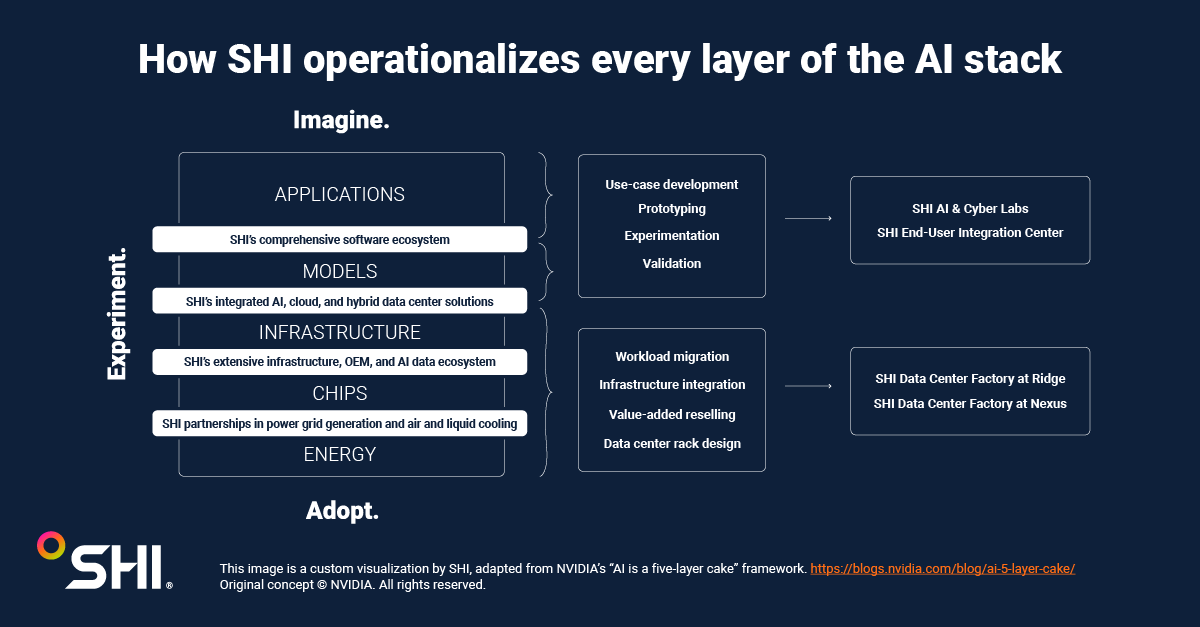
Each phase brings the right layers of the stack into focus at the right time, before early decisions become too expensive to unwind. Backed by NVIDIA’s technology foundation, SHI enables AI layers to connect end-to-end through vendor partnerships and comprehensive wraparound services.
Now, let’s take a closer look at how SHI’s Imagine. Experiment. Adopt. approach enables organizations to create cohesive, scalable, and secure enterprise AI environments.
Imagine.
At this phase, SHI focuses on helping organizations determine where to start. This begins with identifying the critical business objective and where well-designed AI solutions can address execution challenges. Through consultative discovery and readiness assessment with SHI’s AI experts, CIOs define what success must deliver, then identify the capabilities required across the full AI stack. This approach helps avoid diving straight into tool-led decisions that can lead to rework and unnecessary expense later.
What we work through during the Imagine phase:
- The top business objectives the organization is trying to achieve
- Which workflows or functions are most burdened by manual effort
- Whether the focus is solving a specific problem or enabling a broader AI capability
- What success looks like in measurable business terms
By engaging in the Imagine phase, SHI helps organizations establish the architectural and operational clarity needed to move forward with a full-stack roadmap that lays the foundation for experimentation and adoption.
Experiment.
Experiment is where organizations test whether the outcomes defined in the Imagine phase can hold up under real conditions. Through controlled pressure-testing and proof-of-concept validation in SHI’s AI & Cyber Labs, teams assess value, performance, risk, system design, and cost before moving AI initiatives into their own production environments.
What we work through during the Experiment phase:
- Whether any existing services break or degrade when usage scales beyond a pilot
- What operational dependencies or handoffs AI introduces
- How sensitive results are to model choice, prompting, or data quality
In this phase, NVIDIA’s five-layer structure serves as a diagnostic lens for working with SHI. Using controlled testing to surface layer gaps early, organizations know what holds up in practice, what needs adjustment, and whether an initiative is ready to move to adoption.
Adopt.
Adopt is where AI moves from a tested initiative into a production-ready operating reality. At this phase, the challenge is less about technology choices and more about running AI reliably across people, processes, and platforms inside the organization.
What we work through during the Adopt phase:
- How users will be trained, supported, and enabled to use AI confidently in their roles
- How ongoing value and ROI will be measured beyond the initial rollout
- How infrastructure, cost models, and support teams will need to adapt as adoption grows
By the end of the Adopt phase, organizations move beyond isolated deployments and establish AI as a durable operating capability. AI is embedded into day-to-day workflows, supported by trained teams, governed responsibly, and operated at scale.
How the AI stack comes into focus across SHI’s three-phase approach.
Taken together, these phases help leaders slow down, sequence decisions deliberately, and avoid the costly downstream trade-offs that occur when AI initiatives move too quickly to the top of the stack.
Consider a common enterprise AI use case like modernizing an external customer service capability to increase issue resolution speed and improve customer experience. While the idea begins at the application level, delivering it in practice quickly pulls on every layer of the AI stack.
Imagine – outcome-first thinking focused on readiness and prioritization
- Applications layer: Define which customer interactions AI should handle, what success looks like, and where escalation or human interaction is required.
- Models layer: Establish build-versus-buy direction, data sensitivity boundaries, accuracy expectations, and governance intent.
- Infrastructure, chips, and energy layers: Set early guardrails for security, integration, capacity, and cost before tooling decisions are locked in. Define power and cooling requirements needed to support the anticipated workload. These directional decisions shape everything that follows and inform which technologies and partners are a good fit.
Experiment – controlled testing to validate and deliver an MVP prototype
- Applications layer: Test whether prototypes fit into real customer workflows without breaking handoffs or introducing friction.
- Models layer: Pressure-test reliability, grounding quality, and hallucination risk under realistic conditions, including proof-of-concept scenarios. This is typically where short-listed models, platforms, and components from the broader vendor ecosystem are validated before longer-term commitments are made.
- Infrastructure, chips, and energy layer: Validate how latency, security, chip performance, power draw, and cost behave as traffic increases.
Adopt – production-ready execution grounded in security, enablement, operations, and ROI
- Applications layer: Embed AI into frontline workflows as a production-ready operating capability, defining ownership, and training teams so the system is trusted and used consistently.
- Models layer: Shift from selecting to stewarding, while monitoring guardrails and drift management over time.
- Infrastructure, chips, and energy layers: Ensure familiarity with system operations, streamline management of performance and capacity, and optimize cost savings as part of ongoing operations, tying consumption directly back to business value.
SHI turns the NVIDIA AI stack into an enterprise operating reality
NVIDIA’s five-layer AI structure makes it clear that AI outcomes will only hold when every layer beneath it is intentionally built, integrated, and governed. Huang recently said, “AI is no longer a single breakthrough or application — it is essential infrastructure. Every company will use it. Every nation will build it.”
The promise of AI is not just in the technology itself, but in how well it is operationalized. Through Imagine. Experiment. Adopt. SHI can help organizations turn AI ambition into real enterprise transformation and build the foundation to execute and adopt at scale.
NEXT STEPS:
Ready to discuss how your organization can get AI initiatives off the ground?
Connect with one of SHI’s AI experts now and learn more about our NVIDIA partnership.
-
 The soaring scale of NVIDIA GTC alongside AI’s hyperscaling era:
Attendance surged at the Super Bowl of IT this year, reflecting NVIDIA’s expanding market influence and the global pull of American AI infrastructure.Reading Time: 4 minutesNVIDIA GTC’s rapid growth reflects AI’s hyperscaling era as inference, platforms, and governance expand.
Read More -
 How VMware Cloud Foundation will help you privatize AI workloads faster:
VMware vSphere 8 reaches end of support in October 2027. Are you prepared for your VCF 9.x migration — and are you familiar with its built-in AI on-ramp?Reading Time: 6 minutesTurn your VCF 9.x migration into a private AI on-ramp — faster, more secure, and cost-efficient.
Read More -
 How Microsoft is driving the next era of work for 2025 and beyond:
Microsoft’s latest innovations mark a shift from experimentation to strategy. Here’s how to get ready.Reading Time: 5 minutesMicrosoft Ignite 2025 sets the stage for AI-driven work with smarter agents and unified governance.
Read More