
How AI is changing software asset management:
What the 2026 Gartner® Magic Quadrant™ for SAM Managed Services says about a market in transition

SHI has been named a Leader in the Gartner® Magic Quadrant™ for Software Asset Management Managed Services for the first time. We believe AI is changing what organizations need from SAM. But, as AI costs are set across the whole technology stack, SAM can’t manage them alone. This post covers three shifts SAM leaders should plan for, and the questions to take to your next leadership review. It also gives you access to the 2026 Gartner® Magic Quadrant™ for SAM Managed Services report.
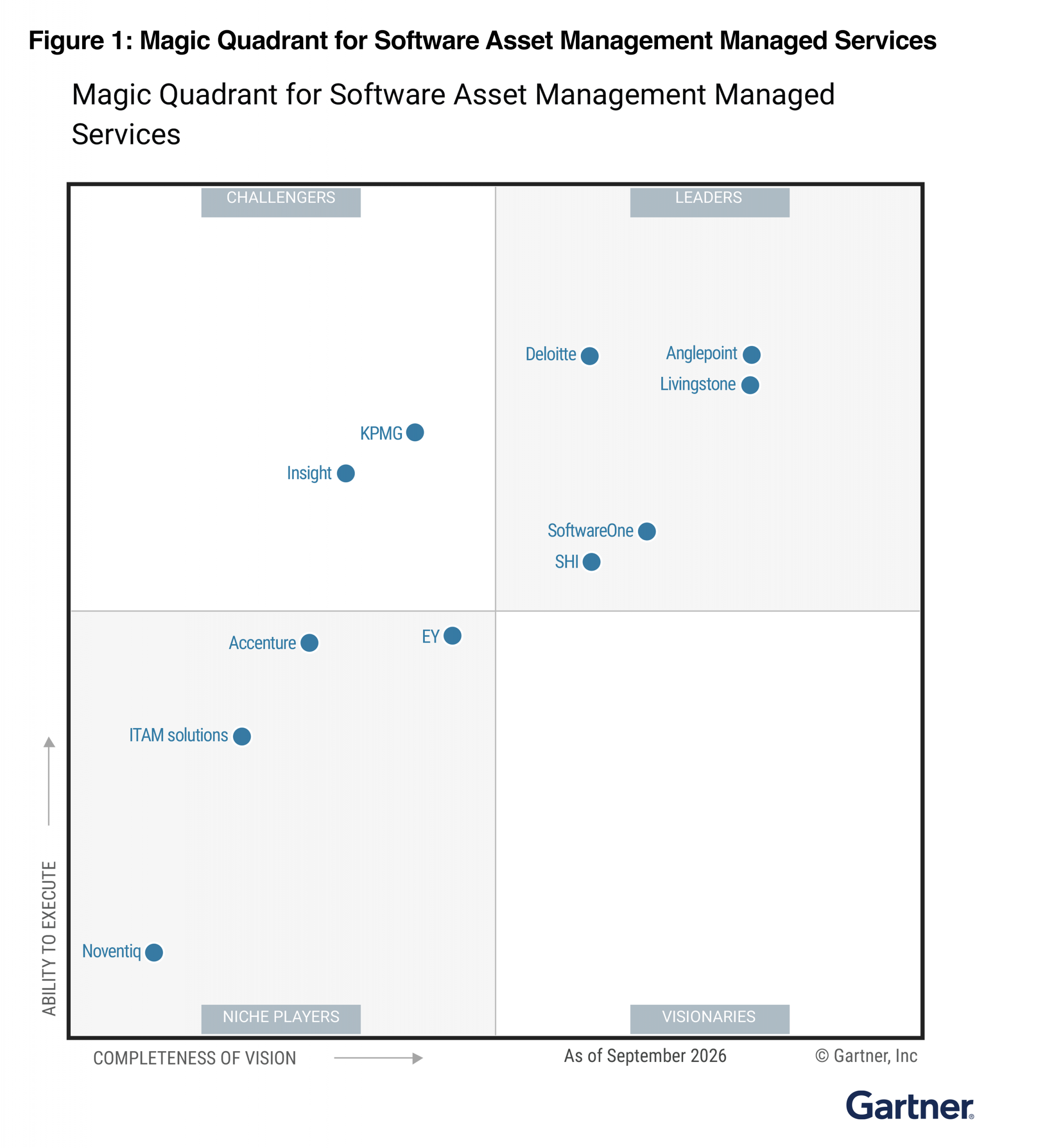 Gartner® has named SHI a Leader in the 2026 Magic Quadrant™ for Software Asset Management (SAM) Managed Services. (Get the report here.) We’re proud of the recognition, and we believe it says something about where SAM is heading.
Across the market, SAM providers now describe their work in much broader terms than audit defense and compliance. FinOps, cloud cost, AI spend, and software value management are all part of the conversation.
AI is driving that change. It’s reshaping how SAM teams work and what organizations want from a provider.
“Organizations are not simply looking for help managing AI token costs or knowing what AI to buy. They need guidance identifying the right use cases, understanding the infrastructure and architecture required to support them, evaluating the financial implications of those decisions, and ultimately implementing and governing those solutions,” said Shane Cronin, Head of FinOps and ITAM Services at SHI.
Why AI cost is a full-stack problem
Cronin helped set up SHI’s AI Cost and Value Management offerings. In his view, you can’t manage AI spend one layer at a time.
“AI economics are driven by the full stack, including infrastructure, cloud, data, platforms, models, software, and ongoing consumption. It’s difficult to optimize AI spend without understanding how all of those components interact. That’s the gap we focus on: connecting business outcomes, technology strategy, infrastructure decisions, and ongoing optimization across the whole lifecycle,” he said.
The standards for AI cost and value are being written now, and we believe SAM practitioners need a say in them. We see three shifts in almost every client conversation, and each one changes what a good SAM program looks like.
Shift 1: From software asset management to software value management
AI breaks the traditional asset management model because it now exists inside software you already own. Some AI is included with your current tier, some is sold as a premium add-on, and a growing share is metered in credits or charged per conversation or action. Vendors are pricing on the value they promise, not the software they install.
A license count can’t tell you whether a premium AI add-on is paying off, or whether credits are going on low-value work. Under-licensing is still a risk, but an even bigger risk is paying for capability nobody uses.
SAM teams already have the skills this needs: licensing knowledge, use rights, and contract terms. Value management applies these skills to a new question. It looks at what each contract contains; measures what the contract returns e.g. cost per active user, take-up of paid AI features, credit use against allowances; and whether the spend is doing what it was bought to do.
Shift 2: From AI spend to AI accountability
Most organizations can now give a rough figure for what they spend on AI. Far fewer can say who answers for it. In Flexera’s State of ITAM 2026 research, 59% said wasted AI spend rose over the past year, and only 31% said they have accurate visibility into AI software.
Part of the problem is timing. Most AI cost is decided at the use case and architecture stage, long before a renewal. By the time SAM sees the invoice, much of it is already locked in.
Accountability means every AI license, credit pool, and token budget has a named owner, a clear use case, and a measure of success, and gets reviewed like any other commitment that size. When the results don’t show up, someone needs the authority to scale it back or move the money somewhere it works.
Shift 3: From visibility to verified outcomes
Data quality matters as much as it ever did. Without credible, complete data, nothing else stands up. But good data stalls when recommendations sit in a dashboard. “Identified savings” no longer carries much weight in a budget review. CFOs want to know what was actually cut or renegotiated, and what it was worth.
We hold our own work to that standard. Our Value Capture platform follows each recommendation from owner and action through to closure and confirmed return, and a closed-loop remediation process keeps it moving.
What role should SAM play in managing AI costs?
No single team can see the whole AI bill. SAM is well placed to join it up, because it understands what architects and FinOps teams often don’t: contracts, entitlements, use rights, and how vendors behave at renewal. That means getting involved earlier, at AI intake and architecture decisions, and working alongside the architects, data and cloud teams, FinOps, procurement, and business owners making those calls.
As AI spend becomes a routine budget line, SAM’s work will increasingly land with the CFO, the head of FinOps, and whoever owns AI in your organization. The teams that can follow that spend across the stack and say what it’s worth will be the ones those leaders turn to.
What should SAM leaders do next?
Three questions are worth taking to your next leadership review:
- Which of our technology commitments can we prove are paying back?
- Who is accountable for the value of each AI investment, as well as its cost?
- How many of last year’s optimization recommendations were delivered?
If you can’t answer all three with evidence, that’s where to start.
NEXT STEPS:
Get a complimentary copy of the Gartner® Magic Quadrant™ for Software Asset Management Managed Services report.Discover our AI cost and value management services.
Speak with an SHI expert about how to get more value from your technology investments.
Gartner disclaimer: Gartner does not endorse any company, vendor, product or service depicted in its publications, and does not advise technology users to select only those vendors with the highest ratings or other designation. Gartner publications consist of the opinions of Gartner’s business and technology insights organization and should not be construed as statements of fact. Gartner disclaims all warranties, expressed or implied, with respect to this publication, including any warranties of merchantability or fitness for a particular purpose.
Gartner and Magic Quadrant are trademarks of Gartner, Inc., and/or its affiliates.
This graphic was published by Gartner, Inc. as part of a larger research document and should be evaluated in the context of the entire document. The Gartner document is available upon request from SHI.
Gartner, Magic Quadrant for Software Asset Management Managed Services, Yolanda Harris, Jaswant Kalay, Rob Shafer, 26 October 2026
Speak with an SHI expert
-
 Technology spend needs a better operating model:
How CFOs can improve cloud, SaaS, and software licensing spend management to reduce waste and protect margin.Reading Time: 6 minutesHow CFOs can reduce cloud, SaaS, and software waste with a better operating model for spend management.
Read More -
 Avoid unknown risks in the era of cloud, SaaS, and AI with 7 best practices:
Don’t gamble with evolving risks — get actionable strategies to prevent, manage, and remediate them.Reading Time: 6 minutesDon’t gamble with evolving risks — get actionable strategies to prevent, manage, and remediate them.
Read More -
 Why ITAM practitioners must evolve for the AI and FinOps era:
AI is changing ITAM. FinOps can help practitioners keep up.Reading Time: 6 minutesWhy ITAM professionals need FinOps skills to manage AI, cloud, and SaaS spend.
Read More