
Five ways enterprises can support the next generation of female tech-sector leaders:
For Women’s History Month, we’re celebrating the incredible women of SHI and highlighting how we empower women across our organization — so you can, too.

Imagine it’s March 12, 1987. The U.S. Congress has just designated March as the first official Women’s History Month.
Weeks earlier, Apple debuted the Macintosh SE — the first compact Mac with an internal hard drive — at Apple World 1987. Weeks later, Microsoft and IBM would announce the release of OS/2, an operating system promising true multitasking on the desktop.
In this era of category-defining personal computing innovation, women earned nearly 34% of all U.S. bachelor’s degrees in computer and information sciences.
Would the rapid growth of the tech sector, together with new national attention on women’s achievement, create the conditions for women to play a defining role in the industry’s future?
As we know now, the reality unfolded with far more complexity. Both progress and setbacks have shaped the last three decades.
Today, women make up 29% of the global tech workforce and just 14% of tech leaders, according to the UN Women Gender Snapshot 2025 report. In cybersecurity, the 2025 ISC2 Cybersecurity Workforce Study shows that women account for 22% of the global workforce.
These numbers reveal a powerful opportunity, as real today as it ever was. Every organization, especially those in technology, can seize it by intentionally supporting women at every stage of their careers.
As the largest privately-held Minority-and Woman-Owned Business Enterprise (MWBE) in the U.S., SHI prioritizes celebrating and supporting all employees, especially women.
Here’s how we’re supporting our own women in tech — and how your organization can, too.
Five ways to support the women in your organization
Being intentional about your internal practices can be a great starting point for shaping inclusivity within your organization’s culture.
1. Encourage employee resource groups (ERGs), committees, and clubs for women
Employee-led groups can take many forms, but their impact comes from the communities they build — not the structure they follow. At SHI, our Women in SHI (WiSH) group hosts engagement opportunities designed to inspire, empower, and encourage collaboration among all employees. Through monthly meetings, learning events, volunteer opportunities, panel discussions, and other initiatives, WiSH brings women and allies together in meaningful ways.
Stratascale’s women’s group, CybHer Collective, meets regularly to discuss topics that pertain to women in tech.
WiSH Co-Chair and SHI Service Delivery Manager Leah Williams-Stephens has seen how new connections can spark new possibilities. “Professional roles are so diverse, especially across a large organization,” she said. “WiSH helps break down siloes and create opportunities for synergistic solutions across departments that wouldn’t have happened otherwise.”
At Stratascale, SHI’s cybersecurity division, employees established a women’s group called CybHer Collective. One way the group fosters connection is through virtual leadership book club meetings, which have sparked meaningful and engaging conversations. Board member of CybHer Collective and Stratascale Director of Cybersecurity PMO Kaitlyn Beaty said, “Coming together as a group of women helps normalize the conversations women may be already having quietly.” She continued, “Together, we can work through things like imposter syndrome, navigating leadership presence, setting work-life boundaries, and being the only woman in the room.”
Inclusive idea: Cohost a women’s learning event, panel discussion, or volunteer initiative with one of your partners, customers, or vendors. Doing so expands relationship-building inside and outside your organization.
2. Establish and advocate for women mentorship programs
For many, mentorship often reflects the collaborative, community-oriented values women uniquely bring to the workplace. WiSH Co-Chair and SHI Business Development Manager Rachel Pizzichillo shared, “I come from a long line of strong women who were big advocates of helping others. It all starts with community-minded women who understand the power of giving back.”
The benefits of mentorship also extend in both directions. Having mentored seven women at SHI, Rachel noted, “Helping others is a win for everyone. When a new employee understands how to do their job better, they’re a better producer and have increased longevity in the organization. When a more tenured employee mentors another, they clarify their thinking, deepen their learning, and get more fulfillment from their job.”
Inclusive idea: If early participation in a mentorship program is low and 1:1 pairings aren’t feasible, start with small cohort-based mentorship groups. This can help build momentum for a greater appetite for mentoring and create space for shared learning as interest grows.
3. Create growth programs that break down traditional blockers for women
Activities like golf, fishing, or poker have long served as informal and influential channels for business networking. Yet women have often had less access and exposure in these spaces, making it harder to participate fully in the relationship-building opportunities where business gets done. In golf, for example, the National Golf Foundation estimates the sport’s total reach at 136 million people, while women make up only 28% of on-course golfers. Here, women also represent a disproportionately high share of beginners, juniors, and off-course participants.

The Business to Golf program gives women at SHI the skills, confidence, and access to step into the game and new professional opportunities
To close this gap, SHI created the Business to Golf program in partnership with Rutgers University and the LPGA Foundation. The program provides SHI employees with the gear, instruction, and on-course experience needed to show up confidently — creating a new space where relationships and careers can grow.
SHI Inside Sales Manager Sarah Waniak praised the program’s impact, “There is always personal and professional growth by doing something you’re not used to doing.” She continued, “Women tend to coordinate with each other when showing up somewhere new. Being a part of this program meant I had no choice but to show up at the golf course by myself. There’s immediate growth in that.”
SHI Client Solutions Executive Ashley Belz emphasized the business value, too. “Golf events occur regularly in our industry and can be a springboard for sales conversations,” she said. “Business to Golf creates a more even playing field for women who work in technological sales roles.”
Inclusive idea: Identify the informal spaces where influence and networking truly happen in your organization. If participation isn’t equally accessible, lower the barriers — offer skills-building, sponsorship, and welcoming on-ramps — so everyone can participate fully and confidently.
4. Give women a chance to step outside their day-to-day and bring their learning back
Professional growth often accelerates when employees have opportunities beyond their daily responsibilities. Conferences, peer groups, speaking engagements, and industry communities can expand women’s networks, strengthen confidence, and create new pathways for visibility.
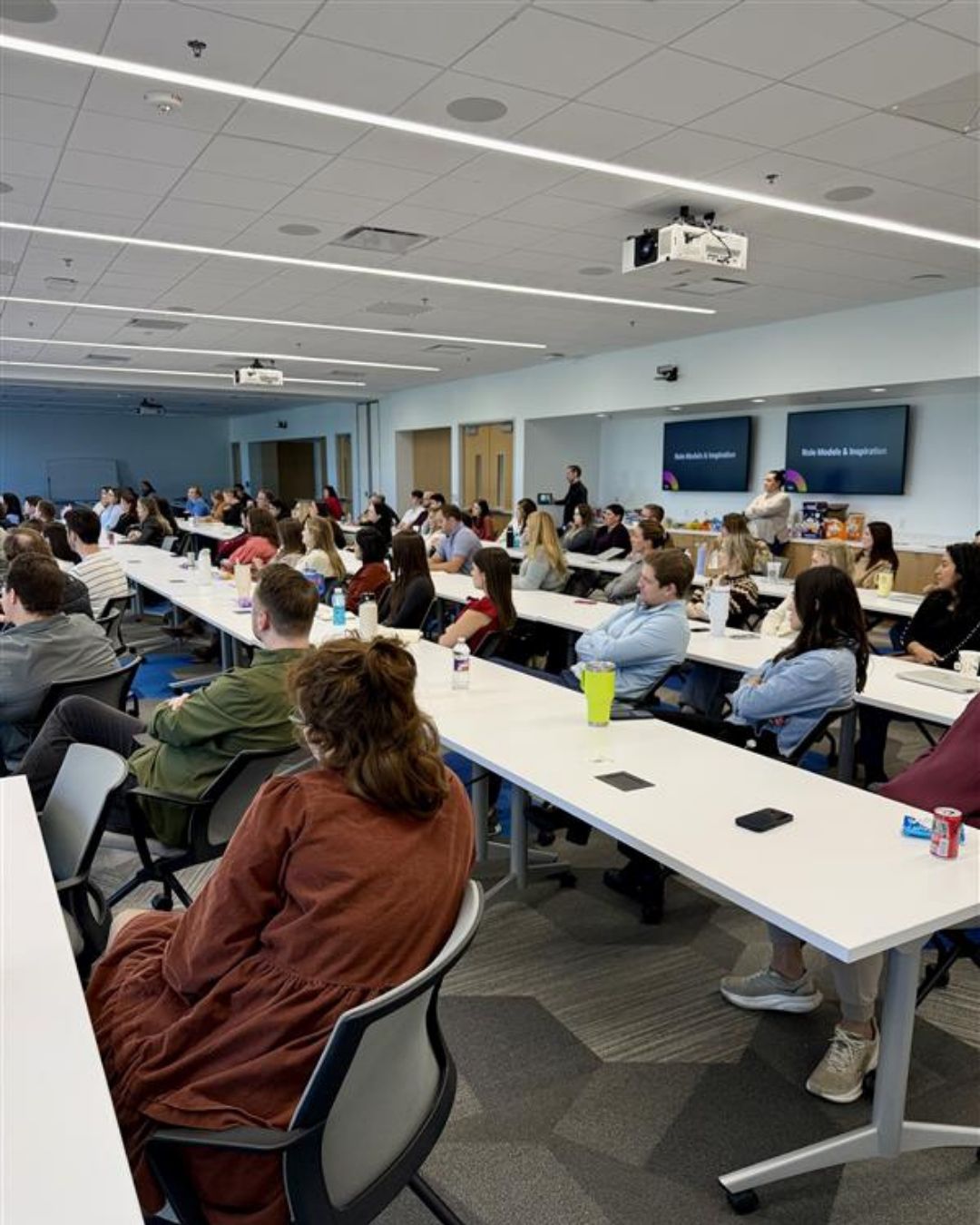
SHI’s CRN Women of the Year finalists share their stories, lessons, and advice with a packed room of colleagues and allies.
Connecting with other women in cybersecurity has been a meaningful career catalyst for SHI Presales Security Solutions Specialist Luz Angeles. As a board member of Women in Cybersecurity (WiCyS) Austin, Luz remembers how challenging it was to put herself out there in the beginning. “My first year in cybersecurity, I felt very alone. But when I connected with WiCyS and women-in-tech groups in my local community, that totally changed,” she said. “It’s silly to think how alone I felt when now I see there’s so much available for me to plug into.”
That same philosophy extends to industry programs designed to support and elevate women, like The Channel Company’s 2025 Women of the Channel. SHI encourages employees to participate in these communities, attend events, and bring new insights back to the broader organization — so one person’s growth becomes shared momentum.
Participation in these communities can also lead to external recognition. When that happens, SHI treats it as an opportunity to celebrate the individuals and, just as importantly, share what they learned. In 2025, seven SHI employees were named finalists in The Channel Company’s Annual Women of the Year awards. Following the event, we hosted internal panel discussions to spotlight the finalists’ career journeys — sparking inspiring conversation and contributing to positive employee feedback and engagement.
Inclusive idea: What opportunities are available to the women in your organization? What ways can the experience and wisdom gained from external organizations, events, and awards be brought back into your organization?
5. Create opportunities for men to be champions, advocates, and allies
Male colleagues — especially those in leadership roles — play a critical part in shaping gender-inclusive workplaces. When men actively model allyship, advocate for women’s expertise, and create authentic spaces for connection, it creates a ripple effect across the organization. For those unsure where to start, intentionally building awareness of how gender bias impacts women in the workplace is a meaningful first step.
SHI Vice President of Security Sales Jared Crowley builds that awareness by creating meaningful opportunities for women to connect outside of work. “Don’t underestimate the power of hosting quarterly informal dinners and social events for the women on your team. There’s tremendous potential for learning and understanding to grow when you get everyone in the same room,” he shared. “Creating space for women to connect also creates new opportunities for their advancement.”
Men in leadership roles can also directly shape how women’s expertise is perceived, especially in technical settings. SHI Data and AI Services Manager Dominick Raimato makes it a practice to validate and elevate the expertise of women on his team. “In technical conversations, it’s important to surface the right voice at the right time. Working in tech, it is common to have twenty people on a call and only one woman,” Dominick said. “If she’s the subject matter expert and her expertise is not being recognized, I will redirect the conversation to ensure her expertise guides the discussion,” he explained.
Inclusive idea: Crafting job descriptions is an area where inclusive design is particularly important. Because the criteria presentation impacts candidate response, it’s essential to develop clearly scoped requirements. Intentionality here can ensure strong candidates don’t self-select out, providing organizations with the most diverse and most qualified candidate pool.
Establishing practices that support women isn’t just for March
While Women’s History Month gives us space to celebrate and learn, the work of supporting women in tech extends far beyond March. Nearly four decades after Women’s History Month was first established — and at another pivotal moment in technology’s evolution — the opportunity to support and celebrate women remains the same.
The women shaping the future of the technology sector are here. With the right structures, advocates, and pathways in place, we have the power to turn the collective potential of individuals into shared progress for all of us.
How will you support and celebrate the women in your organization?
-
 How to escape the 75% transformation failure rate cursing IT adoption:
Adoption and change management helps you tackle the people side of changeReading Time: 4 minutesAdoption and change management helps you tackle the people side of change
Read More -
 How improving clinical mobility helps achieve Quintuple Aim:
To foster great patient and clinician experiences, start by modernizing the devices your people rely on.Reading Time: 5 minutesTo foster great patient and clinician experiences, start by modernizing the devices your people rely on.
Read More -
 4 ways SHI Expert Support helps simplify your IT management needs:
Expert Support provides technical expertise at a rapid speed you can depend on.Reading Time: 5 minutesHere’s why organizations like yours are leveraging SHI Expert Support to solve what’s next for IT management.
Read More